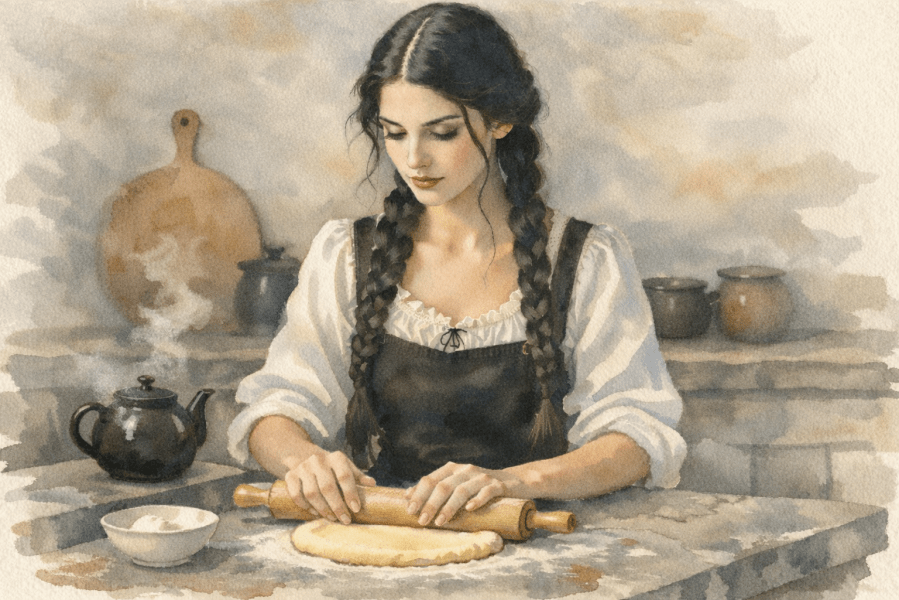
In the kitchen, She rolls out dough on a floured surface.
Sigyn nods to the stool beside the stone island.
I sit. She tells me to get myself some tea,
motioning to the steaming pot, and more if I need it.
She’s making cookies for Her children,
but the house is quiet, no laughter, no running feet.
I notice the tension in Her arms,
the anger pressing through each movement,
and yet the dough spreads perfectly,
a quarter inch thick, smooth and obedient.
I sip my tea, cinnamon and something else,
warming, sweet.
She works the dough, and nothing changes.
That’s what grief can be like,
the appearance of stillness
while we move through it,
trying to make it different.
My head lowers toward the cup in my hands,
its deep gold hue reflecting quiet understanding.
I can’t touch Sigyn’s grief.
All I can do is sit with Her
and be nourished by Her presence.
I can’t avoid Her grief either,
any more than I can avoid my own.
I see it in the stiffness of Her arms,
in the fierce focus of Her hands,
as if through the work itself,
through the dough,
She experiences Her children with Her again.
It’s all She can offer Them:
focus, attention, devotion, emotion, life itself.
The breath leaves me as I realize
these are the cornerstones
of what we give to the unseen.
Noticing.
Feeling.
Receiving.
Living.
 Stara Esoterica